Composer-lyricist Charlie Smalls wrote "You Can't Win" for the stage version of The Wiz (1975), but it was dropped after the Baltimore previews. It originally appeared at the beginning of the second act, where it was sung by the slaves of Evilene, the Wicked Witch of the West. It was dusted off for the film version, where it replaced "I Was Born on the Day Before Yesterday" as the Scarecrow's introductory solo. Michael Jackson's performance in this role is considered by many to be the highlight of the film, and this song to be the highlight of his performance. My conversations with fans of the film, particularly in the Black community, suggest that this is one of the most popular songs from The Wiz, along with "Home," and although it goes against the licensing agreement, many school and community theater productions still use this song instead of "I Was Born."

Monday, October 15, 2018
Michael Jackson sings "You Can't Win"
Composer-lyricist Charlie Smalls wrote "You Can't Win" for the stage version of The Wiz (1975), but it was dropped after the Baltimore previews. It originally appeared at the beginning of the second act, where it was sung by the slaves of Evilene, the Wicked Witch of the West. It was dusted off for the film version, where it replaced "I Was Born on the Day Before Yesterday" as the Scarecrow's introductory solo. Michael Jackson's performance in this role is considered by many to be the highlight of the film, and this song to be the highlight of his performance. My conversations with fans of the film, particularly in the Black community, suggest that this is one of the most popular songs from The Wiz, along with "Home," and although it goes against the licensing agreement, many school and community theater productions still use this song instead of "I Was Born."

Saturday, October 13, 2018
Bert and Ernie Sing "But I Like You"
"But I Like You" is a song by Jeff Moss sung by Bert and Ernie. It first appeared in 1984 and takes place within a classic Sesame Street scenario--Ernie keeps Bert awake by talking and/or singing. This song belongs to a genre I think of as the Bert and Ernie friendship duet. There are only two or three of them, but they bring to the surface what is tacit in many of the other sketches involving the two friends--the intensity of their relationship, whether you think of them as friends, roommates who are almost like brothers, or even lovers. The Tin Pan Alley style of the song evokes the intimacy of the domestic sphere (indeed they sing to each other in bed) as well as the double entendres (exemplified by Cole Porter) that allow listeners to hear the song on multiple levels.
Friday, October 5, 2018
Repas de bébé
One of the first films ever exhibited in public stars a child,
Andrée Lumiere. Repas de bébé (Baby's Meal) was one of the
films exhibited by the Lumière brothers, Auguste and Louis, in Paris on
December 28, 1895. This event, which demonstrated their new cinematograph, is
often cited as the beginning of film as a public form of entertainment (the
cinematograph had the ability to project its image on a screen so that it could
be viewed by many people at once, unlike "peepshow" devices like
Edison's kinetoscope). Andrée was the daughter of Auguste and Marguerite Lumière,
who appear with her in the film. While her parents fuss over her, Andrée allows
herself to be fed by spoon and makes a good effort at taking a bite from a
solid food item. Because this film seems to record a slice of the Lumières’
real family life, this has been called the first home movie. Although the
suggestion of naturalness is strong in the centrality of a baby and the
breeze-blown trees in the background, it is, of course, a staged and performed
scene. As surely as Auguste and Marguerite perform extra exuberance in feeding
Andree while in front of the camera, Andrée delivers her own performance as she
commands her parents' doting attention by her mere presence and alternately
accepts and offers back her food props.
Wednesday, October 3, 2018
Can You Tell Me How to Get to Sesame Street?
The Sesame Street theme song has opened the program since its first episode on November 10, 1969. The lyric, written by Jon Stone and Bruce Hart in collaboration with composer Joe Raposo, describes Sesame Street as a destination ("on my way to where the air is sweet"). Further, it is a destination sought by a speaker without knowledge of its location ("Can you tell me how to get, how to get to Sesame Street?"). The idea of a place "where the air is sweet" seems prompted by the pleasure of a "sunny day." That Sesame Street is kind of a child's paradise is further signaled by references to playing together and friendly neighbors. That it is a magical place filled with the wonders and imagination of the child is made more explicit by the seldom-heard bridge of the song:
It's a magic carpet ride
Every door will open ride
To happy people like you
The opening of doors refers to the inspiration for the name of the show in the expression "Open Sesame," familiar to many kids from the magical story of "Ali Baba and the Forty Thieves."
The world of childhood and the show's educational mission are implied by the music, which uses the most elementary musical relationships in its melody--"sunny day" and "come and play" are set to a falling arpeggiated triad with much of the rest of the musical phrase following scalar patterns. The song is sung by a chorus of children with light, treble voices evoking popular notions of innocent sweetness of childhood.
While Sesame Street itself is, to borrow an expression from Mr. Rogers, a "neighborhood of make-believe," the visuals accompanying the song suggest that kids can find the spirit of Sesame Street in their own neighborhoods and play activities. Kids are shown playing, mostly together but sometimes alone, in urban environments as well as parks and fields that may or may not necessarily be in the city. These images evoke the pastoral as well as the urban--bucolic scenes being especially associated with the Romantic idea of childhood as a thing close to the goodness of nature.
Tuesday, October 2, 2018
Alice's Wonderland: An Early Encounter Between Disney Animation and Its Child
Alice's Wonderland (1923), although it had been produced under Laugh-O-Gram films, was the first film shown to distributors by Disney Brothers Cartoon Studio, which became the Walt Disney Company. In this short, a little girl named Alice pays her first visit to a cartoon studio. The representation of a child as both observer and participant in the making of a cartoon intended for her amusement sets the terms, from this seminal moment, of the cultural work of the Disney empire. Knocking insistently, she finally secures Walt's attention and declares, "I would like to watch you draw some funnies." This statement encapsulates the entire significance of the Disney company, which positioned itself in the marketplace as the safe studio for kids and families, using animation as the medium of choice for demonstrating its child-friendliness and the figure of Walt Disney himself as its imprimatur. Self-reference, to Disney the man, to the studio, and to the technical arts of animation, are on display here, as they often are in animated shorts showing the artist at work and interacting with his creations. This kind of self-reference runs through the Disney corpus, with each film recycling images, tropes, and even specific animated movement sequences from previous films. Walt already is the avuncular figure that he would become to American audiences. The white page on which Walt has been drawing becomes the movie screen as the pictures come to life. Cats play in a band, visually representing in this silent film the important role music would play in future Disney productions. Then, Alice goes home and dreams that she travels to Cartoonland by train, a magical place where a kids' dreams seem to come true and easily seen as an analog to Disneyland. Alice's appearance as a live actor in this cartoon world suggests the immersion of the "real" child in the world of Disney. The dream takes a mild turn for the worse when Alice is chased by lions before waking up (Sorry the very end is missing from this video!). The framing of the adventure as a dream and the name of the protagonist suggest Lewis Carroll's Alice's Adventures in Wonderland (1865), the kind of fantasy story that, along with fairy tales, would form the backbone of Disney's repertory of animated features starting with Snow White and the Seven Dwarfs (1937).
Fairylogue and Radio-Plays
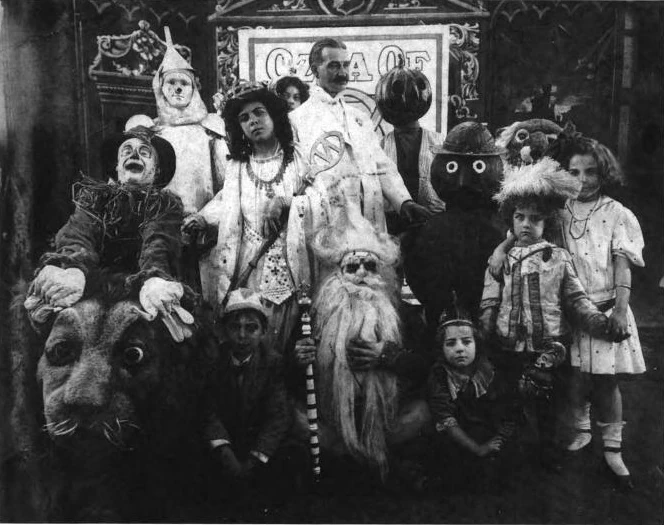
In this picture, L. Frank Baum poses with actors from his Fairylogue and Radio-Plays. Always intent to expand his Oz books into a transmedia franchise, Baum, with this project, created what seems to be a rather unusual media form based on The Wonderful Wizard of Oz (1900), The Marvelous Land of Oz (1904), Ozma of Oz (1907), and one of his non-Oz fantasy books, John Dough and the Cherub.The Fairylogue and Radio-Plays combined hand-colored slide projections and moving film clips with live actors. Baum himself played the narrator in a fashion that sounds reminiscent of popular projection lectures of the nineteenth century, only here he interacted with the movies as well as the live actors. It seems like it was probably as much an advertisement for the books as an attraction in itself. The Fairylogue and Radio-Plays was expensive to produce and to tour. Although it was well-received, it lost money, and the expense sent Baum into bankruptcy. Little more exists of this production than a handful of photographs, a couple of advertisements, and an archived script. None of the slides or films survive, so we'll likely never see those. I am struck by the fact that there are a number of children in the cast, including Romola Remus as Dorothy. I would love to know more about these child actors and how they performed in the show.
Tuesday, September 18, 2018
Mary Poppins Returns
The official trailer for Mary Poppins Returns has just about everything: nostalgia, magic, and a nonagenarian Dick Van Dyke dancing on the furniture.
One thing that's missing is a significant sampling of the songs by Marc Shaiman and Scott Wittman, which I of course can't wait to hear.
If the reaction videos can be taken as a measure, the trailer seems to be cuing all the right emotions.
One thing that's missing is a significant sampling of the songs by Marc Shaiman and Scott Wittman, which I of course can't wait to hear.
If the reaction videos can be taken as a measure, the trailer seems to be cuing all the right emotions.
Sunday, September 16, 2018
Pecan Pie Baby
 Jacqueline Woodson’s Pecan Pie Baby tells the story of an African American girl, Gia, who is less than happy that she is going to have a new sibling. Aimed at young readers, the book, with illustrations by Sophie Blackall, signals its comforting objective from the outset through its pastel colors and the appealingly round-faced characters. The front cover shows Gia and her Mama in close embrace with Gia’s arm around her mother’s pregnant belly after they have just finished eating pecan pie, the food that Mama uses to comfort Gia and reassure her of her love.
Blackall’s illustrations show the relationship between Gia and Mama, using indoor environments, predominantly the home, and Gia's position within them to show her emotional state. The book opens in the fall with Gia and Mama going through Gia’s winter clothes. Instead of throwing them away, however, Mama boxes them up for the new baby. Gia’s room is always shown from a perspective directed toward the far corner, where her bed is situated. In the first two-page spread, the room appears cozy and lived-in, with mother and daughter smiling as they pack up the winter clothes.
 This mood is disrupted in the text, however, when Mama brings up what Gia repeatedly refers to in exasperated larger type as the “ding-dang baby.” On the next spread, Gia looks away from her mother (who is always looking at Gia, no matter what) as she tries to talk to her about the coming baby. In such moments of emotional closeness, Blackwell gives us intimate depictions of the characters with few or no details of their surroundings in the background. The passage of time is indicated by the changing of the season from autumn to winter, which is when, according to Mama, the baby will probably arrive (by the first snow). On the first page, trees in cheerful fall colors are framed by the windows in Gia’s room. After the topic of the baby comes up, falling leaves are foregrounded in an exterior view of Gia’s bedroom window as she looks out hoping there won’t be snow. Framed by the window, Gia looks away from Mama as each falling leaf portends the dreaded winter.
  Mama remarks that the baby loves pecan pie, and it wants some right now. Gia says the baby is just a copy-cat, because the two of them love pecan pie. This conversation takes place on the same spread dominated by the picture of Gia and Mama in the window with leaves blowing across the pages toward the substantial paragraph of text. There is some space after this text before the single line, “In the kitchen, Mama cut us a big slice.” Then, in the lower right corner of page, there is a tiny picture of the two of them seated side-by-side at the kitchen table, sharing a piece of pecan pie. Their eyes are glancing toward each other, and there is something stylized, possibly even suggestive of folk art, about the way the hold their spoons against their smiling lips. Because of the unusual way in which they eat with their spoons, one is prompted to imagine the taste and texture of the pie, which has an affectionate place in Southern and African American culinary history as a dessert associated with family and holidays. Such a significant moment in the story might well have been its own featured page. The choice to slip it into the corner of a two-page spread suggests that it is the little things—small gestures of love and acts of bonding—that matter. It also allows room for this gesture to grow larger and more significant by the end of the book. In these first few expository pages, the full story has been prefigured on a small scale.
As time passes, leaves keep falling, and “jacket weather” comes. Gia’s fear that the new baby will ruin life as she knows it intensifies. There is a moment of playful abandon when Gia and her friends play “Mama’s Having a Baby.” As the children jump rope to the traditional children’s rhyme, Gia blends into the crowd—it takes the reader a moment to spot her near the end of the line. At this moment, she is able to play through her feelings of resentment (in the rhyme, the baby is sent down the escalator) without being singled out as the girl who’s getting a baby sibling, as happens during an episode in class.

 Soon, however, before even arriving, the baby seems to invade Gia's life, world, and physical space. She worries that her friend won't be able to sleep over because the baby will take the extra bed. Her aunties come to visit, but rush through tea and ignore her to talk about the baby, and her uncles invade her room to put the crib together. In a single-page illustration without words, they have strewn furniture parts and tools all over her room, leaving Gia drawn up in fetal position, backed up into the far corner of her room, small and marginalized. At school, the teacher reads a book about a girl who is about to be a big sister, and in contrast to the anonymity she enjoys in the jump-rope scene, she is encircled by her classmates who all look at her.
Gia is sent to her room, where she again sits on her bed in the corner. Her loneliness is deepest here, with the lines where the floor and walls meet converging where she sits in a deep recess of solitude as we look down on her from above. The trees in the window have almost completely shed their leaves.


Judy Garland sings "Over the Rainbow"
Judy Garland is probably best known for her role as Dorothy in The Wizard of Oz (1939) and for her song from the movie, "Over the Rainbow." The song became her signature, and in the 1950s it was a fixture of her concert tours. Typically she sang it right after a recreation of "A Couple of Swells," a clowning song and dance duet which she shared with Fred Astaire in the film Easter Parade (1948). Still in the "tramp" costume from this comedic number, she would sit on the edge of the stage and give a heartfelt rendition of "Over the Rainbow," as though breaking the fourth wall of the preceding comedic performance to bare her soul. In this, the only video of the performance, from her appearance on the Ford Star Jubilee television program of 1955, even as she remains in costume and makeup, the pathos of her real life--the addictions, marital instability, career ups-and-downs, and other struggles of which many of her fans were aware--are foregrounded in a theatrically staged revelation of the person behind the performer.
This revelation of the person behind the performer also plays as a revelation of the child behind the adult. Much has been said about the androgyny of the performance and how Garland's inhabiting the drag of a male tramp intensifies the effect of dislocation--of a person not belonging or not confined by conventional gender and social categories--and the feelings of longing expressed by the song in such conditions of marginalization. Resonances with her gay male and other queer fans is obvious here. Perhaps less obvious, but at least as important, I think, is a kind of age drag. Her tramp character, although an adult, is comically childlike. Indeed, it is an infantalizing portrayal of poverty and, implicitly, race, given its roots in clown stock characters and minstrelsy tropes (which were very much part of Garland's early film career). Whereas in "A Couple of Swells," Garland's tramp is a carefree and child-like adult, in "Over the Rainbow," the character is a window onto the adult's childhood, which persists as the "child inside." Garland's performance channels both the image of the child star's loss of childhood and the impossibility of an adulthood without childlike vulnerability. The poignancy of the performance is, first and foremost, I think, in its queering of the line between child and adult, revealing the latter, in particular, to be a fantasy.
Friday, September 14, 2018
No More Kings!
The "America Rock" episodes of the ABC interstitial cartoon series Schoolhouse Rock presented lessons about American history and democracy that were meant to educate young viewers into citizenship. Schoolhouse Rock used songs in styles of music broadly conceived as rock to help its young viewers remember things like the preamble to the Constitution, adverbs, and multiplication tables. In the case of the nostalgic "America" episodes, a folk-rock sound dominates. The first installment, “No More Kings," opens with an invocation of rock music itself to announce the appearance on the world stage of American democracy:
Rockin' and a rollin', splisin' and a splashin'
Over the horizon, what can it be?
Looks like its going to be a free country.
The song then launches into a narrative of the colonization of the new world describing the proto-USA as a child leaving the nest of mother England.
Oh, they were missing Mother England
They swore their loyalty until the very end
Anything you say, King, it's okay, King
You know, it's kind of scary on your own
Gonna build a new land the way we planned
Can you help us run it till it's grown?
Words, music and image seem designed to tell a story children could relate to. The animation makes the world appear small, so that a ship can easily sail across a small ocean, across which a king can watch his subjects through a spyglass. The Boston Tea Party is represented inside a teacup, which is reminiscent of a child's tea set. The Mayflower and the house, over which people tower, are also toy-like.


The folksy, guitar-based, seventies soft pop style of the music maintains the childlike affect. Most importantly, the pilgrims are described, like children, as dependent on a mother country. They are frightened to be alone in the world, but swearing their loyalty, they want to build a new land according to their own vision. They need help until, like a child, the new nation is “grown.” And they want the king to be proud of them, just as a child seeks a parent’s approval. Both the colonizers and the country they found are thus positioned as innocent by being coded as children.
To maintain the innocence of this narrative, however, requires the erasure of those who would complicate it.

We are told that the Pilgrims are
looking for a land to call their own. We of course know that there are already
people there, a fact which is not acknowledged in the song’s lyrics, and only
marginally acknowledged in the animation as American Indians peer apprehensively from behind
Plymouth Rock. The pilgrims simply “planted corn,
you know” in a landscape represented by a blank page. There’s nothing to see
here, as their crops and houses fill the uninhabited space.
The
king himself is presented as childlike, effeminate, and prone to tantrums. His
authority is replaced in the end by that of men of reason, the founding fathers
who framed the constitution and the declaration of independence. These rational
patriarchs must be defined against their opposites—children, racial others and
the femininely gendered Mother England. It is probably worth mentioning that
the emergence of this species of rational men coincided historically with the
emergence of Romantic, innocent childhood. In this and other "America Rock" episodes, the growth of the nation parallels the growth of the child from a primitive state to a mature one. This growth into Enlightenment rationalist Euro-American adulthood is the basis of Schoolhouse Rock's democracy. Children, while they remain such, along with infantalized non-white adults, are excluded.

Thursday, September 13, 2018
Pestalozzi and Music Education
 Johann Heinrich Pestalozzi, the Swiss educator, held that education should be child centered, teaching the student through natural exploration and play. He expressed his view of the education of the whole person by saying that children should learn by "head, hand, and heart." His belief in the proximity of childhood to nature and the natural education of the child was influenced by the philosophy of Jean-Jacques Rousseau, with whom he shared the belief that speech and sound preceded written words ("sound before sign"). Pestalozzi's ideas were influential on American music education through the work of influential music educators like Lowell Mason. Under Pestalozzian principles, children were most naturally and effectively taught music through singing and playful performance rather than reading and writing music. Such ideas were further disseminated in the twentieth century in the music teaching methods developed by Carl Orff and Zoltan Kodaly.
In this video, music educator Jo Ann Champion traces the lineage of Pestalozzian ideas in American music education.
Tuesday, September 11, 2018
Gallimathias Musicum
I've been listening to Wolfgang Amadeus Mozart's early compositions, and this is one of my favorites. Mozart wrote Gallimathias musicum in 1766, when he was ten years old. It was performed in the Hague for the coming of age of the regent Prince William of Orange the Fifth on his eighteenth birthday, when he was installed as the Stadtholder of the Dutch Republic. Gallimathias seems to mean something like nonsense, gibberish, or a confused state. It's a humorous piece, a quodlibet, which usually indicates a lighthearted composition combining popular tunes in counterpoint. Here, the designation probably refers to the final movement, a fugue on the Dutch tune "Willem van Nassau," which, according to Mozart's father, Leopold, everyone in Holland was "singing, playing, and whistling" at the time.
Saturday, February 25, 2017
Reading and Singing Along to The Wizard of Oz
The first Oz thing I ever owned, long before I had any idea
about collecting, must have been this read-along book and cassette tape: Superscope Storyteller's The Wizard of Oz.
Listening to this again, it occurs to me that
my first awareness of elements of the story that are specific to the book, not
the MGM film, was likely through this adaptation. Dorothy wears
silver shoes, and the witch has one very powerful eye. I especially vividly
remember the lion drinking his green liquid courage in this version. However, whereas these details are true to Baum's book, there are some peculiar differences as well. Dorothy has parents, rather than an Aunt and Uncle, and Toto is white in the illustrations. The story is more
text-heavy than I would normally expect from this kind of product. The
background score is richly orchestrated, showing some significant investment in
the quality of the recording. The voice-over performances are informed by
established expectations about many of the characters. Dorothy has an aw-shucks
way of speaking that evokes Judy Garland in the film, and the Cowardly Lion’s voice involves a confluence of references to Bert Lahr, Snagglepuss,
and Paul Lynde.
The really notable musical feature of the book/tape, however
is a song the Munchkins sing when Dorothy sets of on the Yellow Brick Road, first heard at 2:42, and
which is repeated (though not consistently) as she meets the other characters. Its
words and music are an approximation of Arlen and Harburg’s “Follow the Yellow
Brick Road” from the MGM:
Follow the Yellow Brick Road
That is what many are told
To find the wonderful Wizard
You must follow the Yellow Brick
Road
It’s a pleasant, singable, and memorable tune, if highly derivative of the movie, which, unlike the elements from Baum’s
book, is not in the public domain. It would appear significant that the impulse
to sing and dance was considered a necessary inclusion in this adaptation. I
wonder if this is because of the influence of the MGM film musical. Other adaptations of The Wizard of Oz to book and record also tend to incorporate songs, but this was common practice with many recordings of stories for
children in any case. What is interesting about these book and record texts is
that they combine reading with at least the evocation of embodied performance
through song, dance, and play. The song is certainly catchy enough that one
could sing along to the recording or sing it from memory later while skipping on down one's own imaginary Yellow Brick Road. Reading might be a more embodied experience than one would assume to begin with, but the
ability to read, hear, and even sing and move with the story while reading it
is a type of participatory and embodied reading that has perhaps not been fully
investigated or appreciated--possibly because read-along recordings have not been not
considered worthy of study. What are the forms of literacy that are being
cultivated in this type of reading? What if we gave these books their due
as literature? What are the complex ways in which this text references familiar
elements of the book, the film, and musical theater conventions while
forging its own version?
Tuesday, January 10, 2017
Children of Heaven

In Iranian director Majid Majidi's 1997 film Children of Heaven, Ali loses his sister Zahra's shoes during an errand to have the repaired. Fearful of his father's wrath and conscientious of the family's impoverished financial situation, Ali begs Zahra not to tell him that he has lost the shoes. He offers to share his sneakers, which she wears to school in the mornings. They then switch off in the middle of the day so that he can attend school in the afternoon.
When Ali returns from school after the first day of sharing the sneakers, Zahra says she’s embarrassed to wear the shoes because they are dirty. Ali proposes that they wash them. At this point there is a striking shift in the film’s affective register. Twenty minutes into a movie that has relied on everyday realism and made no use of non-diegetic music, even in the opening credits, music is not only heard for the first time, but is foregrounded, directing the viewer’s consciousness to a different relationship with the film’s diegesis. Ali and Zahra scrub the shoes and then begin blowing bubbles, which seem to dance to the music. The delicate, colorful instrumentation conjures connotations of magic, joy, and the sublime (as well as the exotic, to Western ears). No words are exchanged during this moment. The children smile at each other as they blow bubbles, and when they are done, Ali places the shoes on the wall to dry.
When Ali returns from school after the first day of sharing the sneakers, Zahra says she’s embarrassed to wear the shoes because they are dirty. Ali proposes that they wash them. At this point there is a striking shift in the film’s affective register. Twenty minutes into a movie that has relied on everyday realism and made no use of non-diegetic music, even in the opening credits, music is not only heard for the first time, but is foregrounded, directing the viewer’s consciousness to a different relationship with the film’s diegesis. Ali and Zahra scrub the shoes and then begin blowing bubbles, which seem to dance to the music. The delicate, colorful instrumentation conjures connotations of magic, joy, and the sublime (as well as the exotic, to Western ears). No words are exchanged during this moment. The children smile at each other as they blow bubbles, and when they are done, Ali places the shoes on the wall to dry.
Like bubbles that hang in the air, this moment of lyrical
suspension arrests the linear progress of the narrative, opening a window onto
the special world of the children. Much of the film involves a series of scenes
in which the children navigate their physical environments and social
relationships through progressive, if meandering, movement, often while running
through narrow, winding, walled streets of the south section of Tehran. At
other points later in the film, the foregrounding of non-diegetic music has
varying temporal effects, either magically suspending the action as this scene
does or helping to create forward momentum, as when Zahra loses one of the
sneakers in the gutter and chases it through the streets while the music seems
to give the shoe an enchanted will of its own. In this
particular scene of washing the shoes together, Ali and Zahra share affection,
pleasure, reconciliation, and brotherly/sisterly devotion in a moment of repose
and respite from their difficulties that positions them as idealized,
sentimental, good children. These good children have a closeness to music,
imagination, and nature different from adults.
This scene can be further
understood, perhaps, in the context of post-Revolutionary Iranian cinema. After
the Revolution, the old studio system was dismantled and restrictions were
imposed on the content of films. Adult men and women could not touch each
other, even as actors, if they were not married in reality, and not only overt
sexuality but also singing and dancing were eliminated (Cardullo, 111; Sadr, 228). Children in Iranian film,
who are not bound by the same restrictions and are read as having a fundamental
innocence, have more freedom and mobility that adults. According to both Sadr
and Cardullo, children allow Iranian cinema to address social, political, and
other themes under the inoffensive cloak of child innocence. As Sadr notes
“children liberate plots by introducing non-essential actions [acquiring] a
tone of elevated romanticism that their parents never have” (233). Like Ali,
who is able to get work for his father, these children are more capable in the
modern world than the adults and are portrayed as hard-working (Sadr, 231).
Whereas adult emotion is limited, children show a platonic way of loving (235),
which Sadr associates with Iranian cinema’s “poetic realism.” These films “converted
the question ‘why do people feel this way’ to ‘how does it feel to have such
feelings?’
Subscribe to:
Posts (Atom)